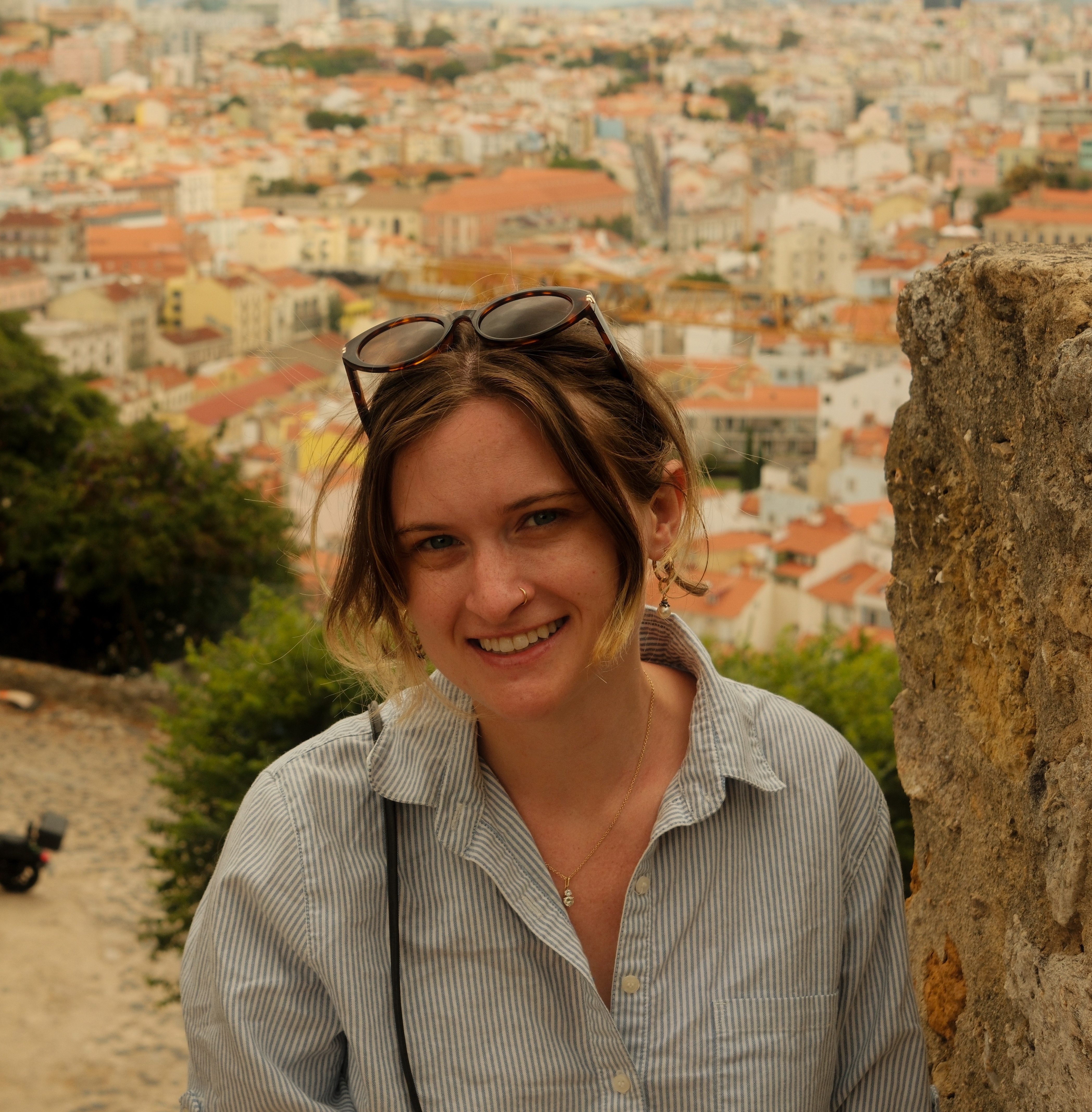
Sixth Year PhD Student • University of Washington
I am a PhD student working with Ali Farhadi at UW. I am interested in Machine Learning and Computer Vision. My past work is in vision and language.
Previously, I worked on the PRIOR team at The Allen Institute for AI under the mentorship of Ani Kembhavi, Luca Weihs, and Mark Yatskar.
I completed my undergraduate degree in Applied Mathematics and Computer Science at Brown University with academic advisor Caroline Klivans.
Email: spratt3 [at] cs [dot] washington [dot] edu
Selected Publications
Ask-E: An Environment for Calibrated Question Generation
Sarah Pratt, Jae Sung Park, Scott Geng, Ali Farhadi
preprint
We present Ask-E, an environment that benchmarks and trains models on their ability to write questions at a given skill level, rather than answer them. A question is successfully calibrated if exactly one of two boundary models can solve it. Training on this environment improves downstream math benchmarks with no new math data, no interaction with stronger models, and no correctness-based reward.
The Emergence of Complex Behavior in Large-Scale Ecological Environments
J. Bejjani, C. Van Amburg, C. Wang, C. H. Su, Sarah Pratt, Y. Mazloumi, N. Khoshnevis, S. Kakade, K. Brantley, A. Walsman
Explores how physical scale and population size affect behaviors in simulated ecological environments.
Superposed decoding: Multiple generations from a single autoregressive inference pass
Ethan Shen, Alan Fan, Sarah Pratt, Jae Sung Park, Matthew Wallingford, Sham Kakade, Ari Holtzman, Ranjay Krishna, Ali Farhadi, Aditya Kusupati
This work proposes Superposed Decoding, a new decoding algorithm that generates k drafts at the computation cost of one autoregressive inference pass.
Can Language Models Use Forecasting Strategies?
Sarah Pratt, Seth Blumberg, Pietro Kreitlon Carolino, Meredith Ringel Morris
This work describes experiments using a novel dataset of real world events and associated human predictions, an evaluation metric to measure forecasting ability, and the accuracy of a number of different LLM based forecasting designs on the provided dataset.
DataComp-LM: In Search of the Next Generation of Training Sets for Language Models
J. Li, A. Fang, G. Smyrnis, M. Ivgi, M. Jordan, ... Sarah Pratt, ... V. Shankar (59 authors)
NeurIPS 2024 (Datasets Track)
A testbed and benchmark for designing high-quality training sets for language models.
DataComp: In Search of the Next Generation of Multimodal Datasets
S. Y. Gadre, G. Ilharco, A. Fang, ... Sarah Pratt, ... L. Schmidt (34 authors)
NeurIPS 2023 (Datasets Track)
A testbed for dataset experiments centered around a candidate pool of 12.8B image-text pairs for training CLIP models.
What does a platypus look like? Generating customized prompts for zero-shot image classification
Sarah Pratt, Ian Covert, Rosanne Liu, Ali Farhadi
This work combines open vocabulary models with large language models (LLMs) to create Customized Prompts via Language models (CuPL). We leverage the knowledge contained in LLMs to generate descriptive sentences for zero-shot image classification.
The Introspective Agent: Interdependence of Strategy, Physiology, and Sensing for Embodied Agents
Sarah Pratt, Luca Weihs, Ali Farhadi
We argue for an introspective agent, which considers its own abilities in the context of its environment. Different environments yield vastly different optimal designs.
Learning Generalizable Visual Representations via Interactive Gameplay
Luca Weihs, Ani Kembhavi, Kiana Ehsani, Sarah Pratt, Winson Han, Alvaro Herrasti, Eric Kolve, Dustin Schwenk, Roozbeh Mottaghi, Ali Farhadi
Oral Presentation at ICLR 2021
Grounded Situation Recognition
Sarah Pratt, Mark Yatskar, Luca Weihs, Ali Farhadi, Ani Kembhavi
Spotlight at ECCV 2020
Grounded Situation Recognition builds upon situation recognition and requires one to not just identify the situation observed in the image but also visually ground the identified roles within the corresponding image.
Teaching
University of Washington
CSE 493: Deep Learning - Instructor (Winter 2026)
CSE 493: Deep Learning - Instructor (Autumn 2024)
CSE 493: Deep Learning - Instructor (Winter 2024)
CSE 493: Deep Learning - Teaching Assistant (Spring 2023)
Selected Lecture Slides:
Brown University
CS022: Discrete Math and Probability - Head Teaching Assistant (Spring 2018)
CS022: Discrete Math and Probability - Teaching Assistant (Spring 2017)
CS015: Introduction to Object Oriented Programming - Teaching Assistant (Fall 2016)